PinSleuth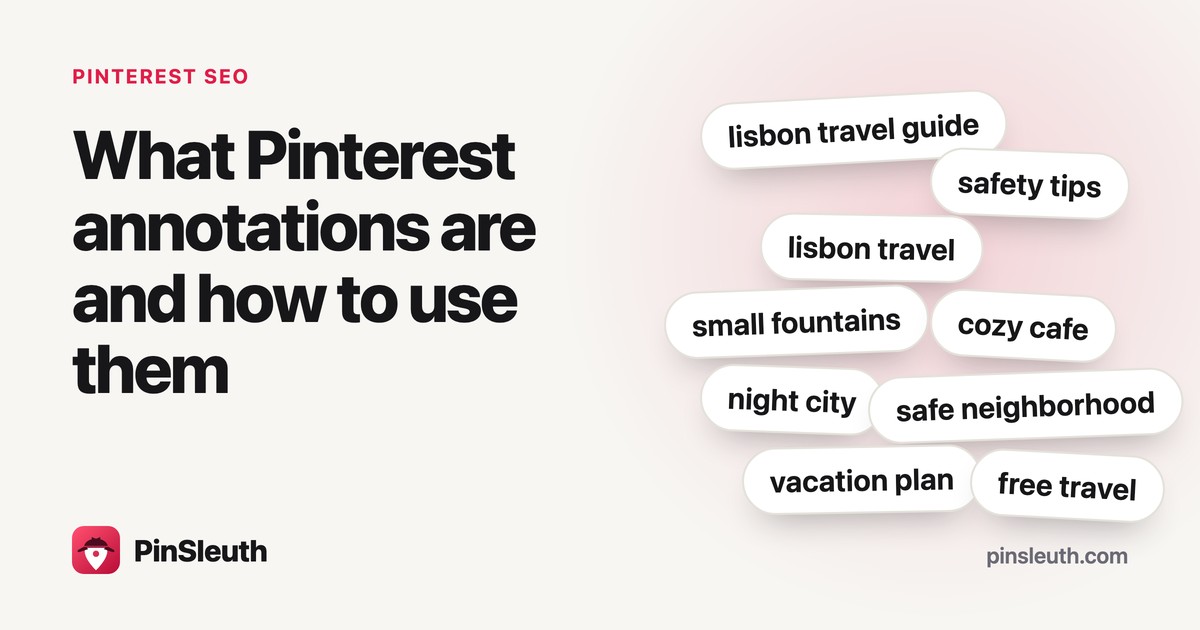
Open any pin and you see a title, a description and an image. What you do not see is the list Pinterest keeps for itself: a set of keywords it thinks the pin is about. Those are annotations, and Pinterest uses them to work out which searches a pin belongs in.
Most advice about Pinterest SEO stops at “use keywords”. This post goes one step further: what annotations are, where they come from, what real ones look like (we pulled them for 60 pins), and how to use them without stuffing your titles.
What annotations are
Pinterest has explained this itself. According to Social Media Today’s report on that explanation (August 2019), Pinterest pulls text from several places on and around a pin: the pin title, description and URL, the board name and description, the title and description of the page the pin links to, search queries that often lead to clicks on the pin, and the names of objects its image classifiers detect.
From all of that it builds a list of keywords with a confidence score for each. The list can include words that are not written anywhere. Pinterest’s own example was that “travel” can be inferred from “visiting”, and “animals” from “sloths”. It also throws away words that say little, such as “world”, “journey” and “read”.
So an annotation is not a hashtag you chose. It is Pinterest’s own guess about what the pin is, built from your text, your board, your page and your image.
What they look like on a real pin
We read the annotations for 60 pins on a Lisbon travel blog we use as a test site. This is the full list for one of them, a pin titled “Is Lisbon Safe for Travelers?”:
- lisbon travel guide
- lisbon travel
- small fountains
- safe neighborhood
- cozy cafe
- night city
- safety tips
- vacation plan
- free travel
Some of these clearly come from the words on the pin: “lisbon travel guide”, “safety tips”. Others are not words anyone wrote there. “Small fountains”, “cozy cafe” and “night city” look like they came from the image. We cannot see which signal produced which annotation, so treat that as an educated guess, not a fact.
Three things we noticed
1. Older pins have annotations, brand-new pins do not. All 49 pins older than 60 days that we checked had annotations. The only four with none were a day old. Pinterest does not publish how long it takes. People in the Pinterest community often say about a month, but we have not verified that ourselves, so we would not plan around a number.
2. Nine looks like a ceiling, not a count. 54 of the 60 pins returned exactly nine annotations. That points to a limit on how many Pinterest makes visible, not on how many a pin has. We would not read anything into “nine versus eight”. What matters is which keywords are on the list.
3. The list mixes topic and mood. “Lisbon travel” and “safety tips” describe the subject. “Cozy cafe” and “night city” describe what the picture feels like. That mix is one reason two pins for the same post can end up with different lists.
Why this matters for your titles and descriptions
Pinterest’s own help center says a pin’s distribution depends on relevance, and it recommends putting relevant keywords in the pin title, pin description, board titles, board descriptions and website URL. That lines up with how annotations are built. The text you control is the raw material, and the annotations are what Pinterest makes of it.
It also explains why a pin that ranks well for a keyword often shares annotations with the other pins on that results page. They have been read as being about the same thing.
How to use annotations on your own pins
- Pick the keyword you want the pin to be found for.
- Look at the pins that already rank for it and note which annotations they share. As far as we can tell Pinterest does not show this list on the pin itself, so you need a tool that reads Pinterest’s public data. PinSleuth shows it for any pin or keyword (how that works).
- Compare with your own pin. Which of the shared keywords are missing from your title, description, board name and the page the pin links to?
- Add the ones that honestly describe your pin. Put the main keyword in the title, and let the description cover the supporting ones in a sentence a person would want to read.
- Do not stuff. A pile of keywords does not make a pin more relevant. It makes it harder to read, and Pinterest says it removes keyword-like terms that carry no meaning.
- Check again later. Look at the annotations again after a few weeks. We have not measured how quickly edits show up, so give it time before you change things again.
Mistakes we would avoid
- Copying annotations that do not describe your pin. Pinterest asks that pins match their landing page. A keyword the page does not cover is a promise the pin cannot keep.
- Forgetting the board. Board names and descriptions are one of the text sources Pinterest reads. A board called “Stuff I like” gives it nothing to work with.
- Forgetting the page. The title and description of the page a pin links to are read too. If your post title is vague, your pins start from behind.
Questions people ask
Can I add annotations myself?
No. You write the text and Pinterest generates the annotations. The only way to influence them is through the title, description, board, page and image.
Are annotations the same as hashtags?
No. A hashtag is something you type. An annotation is generated by Pinterest from everything it can read about the pin.
See them for your own pins
Seeing the annotations on the pins that rank is the quickest way to find the words your own pins are missing. PinSleuth shows them for any keyword, compares your pins against the winners, and watches your pins so you can see when they change. You can also start with the keyword research that decides which pins are worth the effort.
Sources
- Pinterest Help: Pin performance and distribution
- Social Media Today: Pinterest provides insights into how it uses text elements in Pin discovery (1 August 2019)
- Pinterest Engineering: Pin2Interest, a scalable system for content classification (further reading)
The pin examples come from a single test blog. The counts are from our own checks and are not a study.