PinSleuth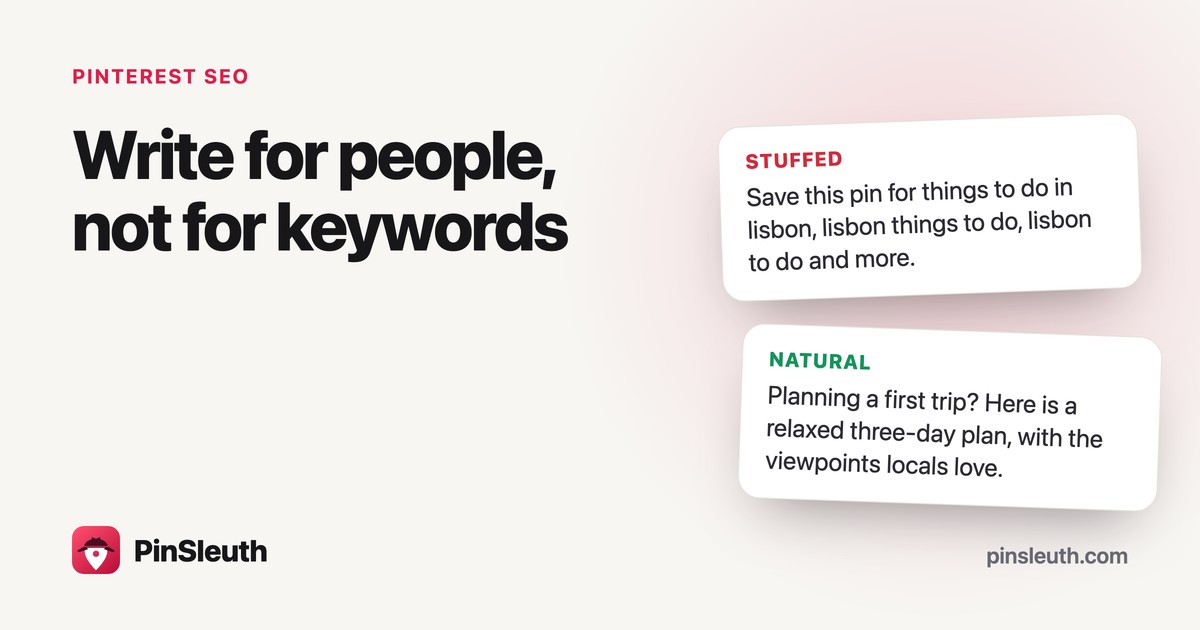
Here is a Pinterest description that looks like SEO and reads like a spam filter: “Looking for things to do in Lisbon? Save this pin for best things to do in Lisbon, Lisbon things to do, Lisbon to do and more.” The keyword appears four times in one breath, and nothing in it tells you what the pin actually shows.
It is easy to end up here. Advice says to use keywords, tools list keywords, and the temptation is to paste the whole list in. This post is about the alternative: writing something a person would want to read, while still giving Pinterest the words it needs.
Why stuffing does not help
Pinterest builds its own list of keywords for every pin, the annotations we wrote about in a previous post. It reads your title, your description, the image and the page you link to. It does not need your keyword said four times to understand what the pin is about, and a repeated phrase tells it nothing new.
Stuffing also hurts with the people who matter. A description that reads like a list gets fewer saves and clicks, and those are the signals you want. We cannot prove how Pinterest weighs a stuffed description, and nobody outside Pinterest can. What we can say is that it is a bad read, and a bad read is a risk with nothing to gain.
A simple way to write it
- Pick one main keyword for the pin, the phrase you most want it to be found for.
- Put it in the title once, near the start if it reads naturally. Titles can run up to 100 characters, but only the first part is always visible, so lead with the point.
- Write the description as two or three real sentences. Say what the pin shows or what the reader will get. Use the keyword once, in a sentence that would make sense without it being a keyword.
- Add supporting ideas only where they are true. If the pin really covers sunset viewpoints and cheap lunches, say so in plain words. If it does not, leave those words out.
- End with a gentle invitation such as saving the pin or reading the guide. No hashtags are needed.
- Read it out loud. If you would not say it to a friend, rewrite it.
Before and after
| Text | |
|---|---|
| Stuffed | Looking for things to do in Lisbon? Save this pin for best things to do in Lisbon, Lisbon things to do, Lisbon to do and more. |
| Natural | Planning a first trip? This is a relaxed three-day plan with the things to do in Lisbon that locals actually enjoy, from sunset viewpoints to tiny lunch spots. Save it for your itinerary. |
The second version has the keyword once, says something specific, and still carries the supporting ideas, “viewpoints” and “lunch spots”, because they are true of the pin.
Where annotations fit
Annotations are useful as a research tool, not a template. Look at the annotations on pins that rank for your keyword to learn how Pinterest understands the topic. Then ask honestly which of those ideas your pin covers, and describe those in your own words. The ones it does not cover are not for you to claim.
A quick check
- Is the main keyword in the title, once?
- Does the description say what the pin offers, in whole sentences?
- Is any phrase repeated, or are there three or more search phrases in a row?
- Would you be happy to put your name under it?
If you want a second pair of eyes, PinSleuth’s Chrome extension scores a draft on Pinterest’s pin page and flags repeated keywords and phrase lists. Its AI writer is told not to stuff, and its drafts are rejected and rewritten if they do. Either way, the final read is yours.